
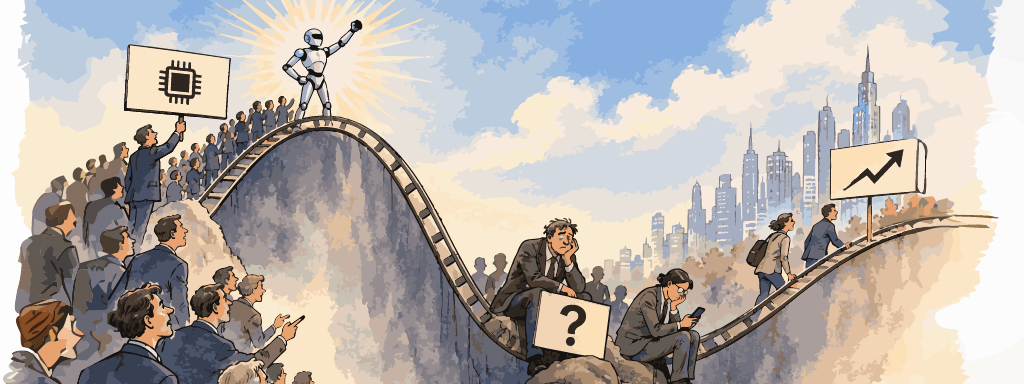
Every new technology arrives with a promise and a reality. The distance between these two is where technological bubbles are born, and where a considerable amount of money, effort and common sense tends to disappear.
The Gartner Hype Cycle offers a familiar description of what happens next. A technological innovation triggers a wave of excitement, expectations rise far beyond what the technology can currently deliver, and reality eventually catches up. The Trough of Disillusionment follows, often accompanied by declarations that the entire thing was a waste of time and resources. Only later, after the noise has subsided, do we begin to discover where the technology is genuinely useful. Eventually, the technology may reach widespread adoption and productivity. See the infographic below.

Artificial Intelligence has followed this general pattern with remarkable accuracy. Language models went from interesting research projects to proposed solutions for almost every problem in business and software development. Suddenly, writing code was “obsolete”, autonomous agents were going to run entire companies, human involvement was unnecessary, and every product that did not have an AI component (or wasn’t marketed as AI-ready) was in danger of being left behind.
There was, of course, something real underneath all this. Language models represent a substantial technical achievement and they can perform tasks that would have seemed improbable or impossible only a few years ago. The mistake was assuming that the ability to generate plausible continuations of text, impressive as the resulting capabilities can be, would translate into reliable, economical, general-purpose automation without substantial additional engineering.
Are We Yet in the Trough of Disillusionment?
The interesting part of the Gartner Hype Cycle is not the peak itself, but what happens when reality starts catching up with expectations. At the peak, every new capability is evidence of an impending revolution. At the bottom, the same capability is dismissed as a gimmick because it failed to deliver the revolution. Somewhere between these two interpretations lies the technology’s actual value, which tends to be considerably more interesting than either extreme.
The Hype Cycle is a conceptual model, not a prediction that every technology must follow the same trajectory. Some technologies never make it beyond the initial excitement, while others find practical applications without going through a particularly dramatic period of disillusionment. Nevertheless, it provides a useful way to examine what is happening around AI.
Exhibit A: Stock Market
The stock market may be giving us an indication of where we are in the cycle. Throughout October and November 2026, AI-related stocks have faced growing pressure as investors question whether the enormous investments in data centers, chips and computing infrastructure will generate returns that justify their cost.
The initial warning signs appeared before the latest developments at Nvidia. Companies such as CoreWeave, Nebius, Oracle and Dell experienced substantial volatility as investors began questioning the economics of the infrastructure buildout. Semiconductor companies, including Micron, Applied Materials and Marvell Technology, were also caught up in the broader reassessment.
The problem is not necessarily a lack of demand for AI computing. Quite the opposite. Demand remains substantial, and some of the largest technology companies continue to report enormous growth in AI-related revenue. The question is whether the economics of supplying that demand make sense.
Building data centers requires enormous amounts of capital, long-term commitments, expensive hardware and access to increasingly scarce electricity. Much of this infrastructure is being financed through debt, investment partnerships and arrangements involving the very companies that supply the hardware and computing capacity.
This creates an interesting financial relationship. Nvidia, for example, is not merely selling chips to companies building AI infrastructure. It has also invested in AI companies and infrastructure providers, helping finance an ecosystem that subsequently purchases its products. Such arrangements can accelerate growth, but they also raise questions about how much of the demand is ultimately supported by independent customers and how much depends on continued financing from within the ecosystem.
Investors are increasingly looking at these relationships rather than simply extrapolating revenue growth into the future.
The Nvidia crisis
Then came the Nvidia scandal.
Jensen Huang, the company’s long-time CEO and arguably the most recognizable face of the AI revolution, became the center of a major controversy involving personal relationships and national-security allegations. The situation led to an investigation by Nvidia’s board, Huang’s departure from the company, and ultimately his reinstatement as the CEO. All within 11 days. The controversy created an extraordinary leadership crisis for a company whose public identity and investor confidence have been so closely tied to one individual.
The situation became more serious when reports emerged that the US Securities and Exchange Commission was investigating Nvidia’s accounting practices. According to Reuters, investigators are scrutinizing potential accounting issues, including questions surrounding the company’s financial relationships with customers and infrastructure providers. An investigation is not evidence of wrongdoing, and its eventual outcome remains unknown. But the timing could hardly be worse for Nvidia. Investors were already questioning the sustainability of AI infrastructure spending, and the company’s role in financing parts of that infrastructure makes transparency particularly important.
Nvidia shares have fallen dramatically from their October highs, losing a substantial portion of their market value. Other AI-related companies have suffered as investors reassess their exposure to the same ecosystem.
The Anthropic IPO
Perhaps the most interesting development came from a company on the other side of the AI industry. Anthropic, the company behind Claude, completed its initial public offering in November. The company raised approximately $81 billion through its public offering, $93.5 billion after the over-allotment due to strong demand, and additional private-placement financing bringing the total proceeds to over $119 billion. Its shares were priced at $83, giving it a valuation of ~$1.5 trillion.
But the financial details accompanying the IPO were equally interesting. Anthropic has enormous computing requirements and substantial infrastructure commitments. Its filings disclosed billions of dollars in operating costs and significant losses, alongside rapid revenue growth. It also has commitments approaching $900 billion related to future computing infrastructure.
These figures do not necessarily indicate a fundamentally unhealthy business. A company investing heavily in infrastructure and research can reasonably operate at a loss while building its customer base and expanding its capabilities. Anthropic also has substantial commercial traction, with thousands of customers generating significant recurring revenue. However, the figures demonstrate the scale of the financial bet being made on the future of AI. Even a company with impressive revenue growth must eventually demonstrate that its customers generate enough value to justify the enormous cost of providing its services.
The IPO initially appeared to confirm that investor enthusiasm remained intact. Yet the optimism did not last long. Following its first day of trading, Anthropic shares fell sharply, surrendering much of their initial gains (Anthropic shares closed at $97.17 in their first day of trading, a gain of 17% from the IPO price) as the broader technology market experienced a dramatic sell-off.
On November 20, the Nasdaq fell 5.3% in a single session and lost approximately 10% over the week. Nvidia dropped around 14% that day, while Anthropic also declined 8.5%. Today, Tuesday Nov. 24, the stock fell below the offer price. Anthropic was trading at $77.65 after markets opened on Tuesday, after closing at $87.64 on Monday. Semiconductor stocks suffered broadly.
The juxtaposition was remarkable. The largest AI IPO in history had just demonstrated extraordinary demand for AI investment, yet the market was simultaneously questioning the valuations and financial assumptions of the industry.
The technology may be valuable, the demand may be real, and the long-term opportunity may be remarkable. None of those things automatically makes every investment in the ecosystem profitable.
While a correction in AI valuations does not necessarily mean the technology itself has reached its trough, the current developments offer a useful clue: the financial market is beginning to demand evidence where it previously accepted promises. That could be the beginning of a painful adjustment for companies whose valuations depend on limitless growth. It may also mark the beginning of a more productive phase for the technology itself.
Exhibit B: Questions
Perhaps the most telling sign of disillusionment is the changing nature of the questions.
During the peak of inflated expectations, the question was how much of a particular activity AI could replace. Now, increasingly, the question is whether replacing that activity makes any sense.
How much supervision does an agent require? What happens when generated code has to be maintained? What is the total cost of a generated result once verification and correction are included? Does automating a task make the overall process better, or does it simply move the work somewhere else? Does it actually make it slower? And how much of the promised productivity improvement survives contact with an actual business?
These are the kinds of questions that should have been asked all along, but they were difficult to hear over the excitement.
It is tempting to interpret this shift as evidence that AI has reached its limits, but that would be a mistake. A correction in expectations is not the same thing as a reversal in technical progress. The technology can continue improving even as the claims made about it become less extravagant. In fact, a more realistic understanding of its limitations may be exactly what is needed to make it useful. Better and better things are still being built for the Commodore 64.
When a technology is expected to solve everything, there is little incentive to examine the details of individual problems. Every difficulty becomes a temporary obstacle to be overcome by a more capable model, a larger data center, or a more elaborate agent. Once those assumptions lose their appeal, the incentives change. Engineers can focus on the specific tasks where language models offer an advantage, combine them with conventional software, and design systems around predictable, deterministic behavior.
What Awaits on the Upward Slope
Instead of trying to make every application autonomous, we can build tools that use language models for the parts of a workflow where they are useful while leaving deterministic operations to deterministic software.
A well-defined deterministic operation is easily between 1,000 and 1,000,000 times faster than an agent trying to figure something out, while achieving 100% accuracy in results.
Instead of expecting a model to understand an entire business, we can give it access to well-defined information and narrowly scoped actions. Instead of treating human supervision as an embarrassing temporary limitation, we can recognize that human judgment is often an essential component of a successful system.
A tool that reliably saves somebody twenty minutes every day is more useful than an agent that occasionally performs an hour of work in seconds but requires constant supervision and unpredictable amounts of correction. A model that can extract structured information from thousands of documents may deliver more tangible value than a general-purpose assistant that claims to understand an entire organization.
The next generation of useful AI products may therefore look considerably less spectacular than the demonstrations that launched the current boom. They may be narrowly focused, integrated into existing software, and designed around tasks that can be measured and verified.
That is not a limitation to be embarrassed about. It is how useful software is built.
Are We There Yet?
We may not yet be at the bottom of the trough in financial terms. There may be more promises, more spending, and more disappointment ahead. But the more important transition may already be taking place – in how we evaluate the technology.
The assumption that every new capability must lead to a universal transformation is giving way, however slowly, to the more useful question of what the capability is actually good for. Technology becomes productive not when its advocates persuade everyone that it can do anything, but when software engineers and managers understand what it does well, where it fails, and how to incorporate it into systems that remain useful when the demonstration is over.
If we’re approaching the bottom of the trough, this is the time we can peek across the valley and see the useful things that are waiting to take shape.
Summary
The Trough of Disillusionment is an unfortunate name for a potentially useful phase of technological development. Disillusionment means disappointment, losing an illusion, not necessarily losing the thing that inspired it.
We may be disappointed that language models cannot do everything we were promised, but that disappointment also gives us a better starting point for understanding what they can do.
The latest developments in the AI industry illustrate this distinction rather well. Nvidia’s crisis, the enormous Anthropic IPO and the subsequent market sell-off are not evidence that AI has suddenly stopped working. They are evidence that the financial and commercial assumptions surrounding the technology are being tested.
The next generation of useful AI products may not look much like the demonstrations that launched the current boom. They may be less autonomous, less general-purpose, and considerably less spectacular. They may also be cheaper, more dependable, and better suited to the problems people actually have.
They already need to be. The initial “take all these free tokens” gold rush is long gone, and computing capacity is no longer something that can be treated as an unlimited, inexpensive resource.
We do not need artificial intelligence to fulfill every prediction made about it. We need it to solve enough real problems, at a reasonable cost, to earn its place alongside the technologies we already use.
There is reason to be optimistic. The spectacle is losing its power to define the discussion, and the practical work is beginning to matter again.
This may well be the point where the story finally becomes interesting.




Leave a Reply